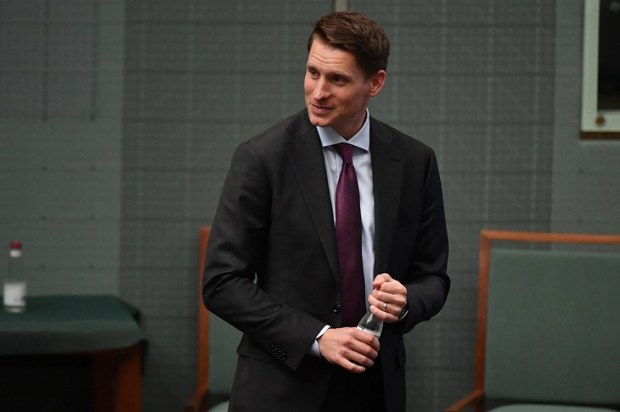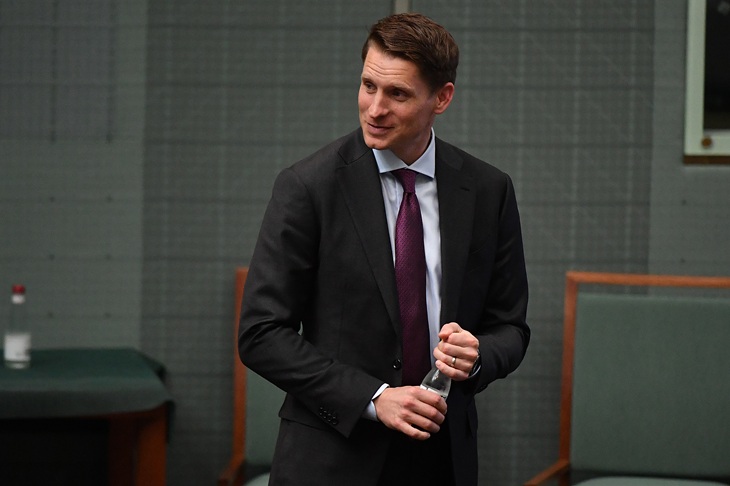
While the factional sharks allegedly circle Angus Taylor, having perceived him as a threat to the future power of the Left within the Liberal Party, speculation turns to Andrew Hastie and whether or not he is waiting in the wings.
Mr Hastie is another fan favourite for conservative voters, and a name often brought up when people fantasise about their dream leadership team.
Speaking to Sky News Australia, Andrew Hastie first confirmed why he stayed out of the recent tussle between Sussan Ley and Angus Taylor.
‘It [leadership] is a challenge with a young family, as you’d know. I’ve got a 9-year-old, a 7-year-old, and a 3-year-old. I spoke to my wife, Ruth, and it was very clear that I wasn’t in a position to lead and be a good dad and husband at the same time. And you know … as a dad as well, you only get one shot at it and I decided that I owe that to my family first and foremost.’
Beyond his family obligations, Mr Hastie has also expressed a desire to spend some time listening and being humble. As one of the few to be re-elected with a rise in support, the speculation about his future at the top of the party isn’t going anywhere.
Mr Hastie went on to stress the importance of discovering why the campaign failed to connect with the Australian people.
For his own part, he expressed regret that his defence plan was released too late in the game, only ten days before the election. ‘There is not a whole lot of reasons to go out and talk about defence policy when you don’t have one yourself.’
It is not so much that he was sidelined, but rather the party hadn’t given him anything firm to promise.
Responding to questions about the quality of his relationship with Peter Dutton, he said, ‘I had a good professional relationship with Peter Dutton … well, you know, you don’t go into Parliament looking to be best friends with everyone. He had a very busy job. I did what I had to do. He did his job. And there’s a lot of things we can learn from this campaign.’
One of the more difficult questions referenced the extremely large and powerful Chinese migrant vote. He was asked, ‘How do you temper your language now or position your polices against China, which is obviously trying to intimidate this region, without isolating the Chinese vote?’
‘The key is social cohesion. And I think, first and foremost, we’ve got to really work hard to demonstrate that we’re for all Australians. That we do recognise that there are many people from different heritages and backgrounds in this country. And that doesn’t mean that we pull our punches when we talk about strategic issues and some of the threats and challenges that we face, but it just means that we’ve got to work extra hard to make sure that our communication is clear and that we are bringing everyone with us. I don’t have an answer exactly for that question.’
During his discussion, Mr Hastie notes that voters are less likely to care or listen to campaign policy ‘if there are far more primal issues that they’re having to deal with’ which is true, but it is not the whole story.
So far, the Liberals have been quiet on the topic of university-educated people voting for Labor’s promise to cancel part of their debt. There are nearly 3 million Australians with a HECS debt. Around 300,000 graduate every year. This voting base will be fiercely loyal to the Labor Party while freebies are on the table.
‘I want to be a national policy maker,’ said Mr Hastie. ‘I want to look at national legislation and make national decisions. But the reality of modern politics is that you also have to be very local and sensitive to the issues that people are facing every day in their lives. And I think we need to do a better job of listening, first and foremost.’
What did the Liberal campaign get wrong?
He went on to speak about the pressure families are under and how the economy is not working for them. Which, to be fair, is not an explanation for the Liberal Party failure of policy.
‘People are frustrated with our education system. The NAPLAN results speak for themselves. One-in-three kids are falling behind in numeracy and literacy and we know that a lot of small businesses have closed or are under immense pressure over the last three years or so. People wanted solutions to those problems and we really need to rethink how we approach them.’
Which was somewhat of a non-answer.
The reporter pressed Mr Hastie on ‘female city voters’ and migrants.
(I am one of those ‘female city voters’ and the answer to that is simple. Stop taxing away my earnings and stop flooding my city with foreigners. This no longer feels like my home and soon it won’t be my home at all because I am in line behind the new arrivals for a vanishingly rare, unappetising, and over-priced rental market. Women like me are not asking for handouts, we want the government to stop milking us for handouts.)
His reply is a little different.
‘I think there are four great enterprise institutions which are at the core of Australian society. The family, the home, our schools or education system, and small businesses. And I think we’ve really got to focus on helping them along, getting them going. That’s where all the magic happens. That’s where people take risks. That’s where people grow as Australians. And I think we’ve got to look at ways to improve those. And every single policy question should be hooked onto those institutions. How can we make our families stronger? How can we get more young Australians into homes? How do we make our schools better? And how do we get our small businesses firing? These are the sorts of questions we need to be asking.’
Following this, he threw his support behind Sussan Ley, which he pretty much has to do, saying they have a big job ahead and that the new leader will last the full term to see the next election. Mr Hastie is happy to serve wherever he is asked to serve. That is up to the leader, he insisted.
‘If we don’t get our act together as a party we are going to face an even more challenging election in three years.’ He added that he was keen to get the party moving again, and that there was a real intellectual contest ahead.
Does he want to lead the party?
‘I made clear in my podcast, I have a desire to lead. But that was in the context of why I didn’t put my hand up … it was an honest question, I gave an honest answer. Had the result been different, it would have been the same answer. So, I don’t think there is anything to be read into that except to say, there is a lot of people who go to Parliament with the hope of leading one day. Timing is everything. Sussan is our leader. She is the first woman in our history to lead the party. I want her to succeed. If she succeeds, we all succeed.’
He would not be pressed further than those generalities, before he was hit with the rather fanciful question about whether or not the Coalition would stay together.
With both parties reduced to such low numbers, parting ways at this point would be like the last two surviving characters in a horror film separating to check out an ominous sound in a haunted house.
‘We will work through whatever issues there are and we’ll come into the next Parliament … as a really strong Coalition.’