According to a superfluity of economic experts and no fewer foreign policy wonks, on 2 April Donald Trump became the character in David Bowie’s song, ‘The Man Who Sold the World’. With one tragic/farcical performance in the White House’s Rose Garden, Trump would unleash inflation at home, trigger a global trade war, tank Wall Street, shatter the Trans-Atlantic Alliance, unite the rest of the world behind China and write off his second term before it had barely started.
In the short term, at least, these dire predictions appeared to be coming true. Stock markets around the world cratered, the European Commission’s Ursula von der Leyen warned of emerging ‘countermeasures’, and Beijing began to sound out Europe, Southeast Asia and even Australia on the prospects of forming an anti-America trading bloc to protect themselves against Trump’s ‘unilateral bullying’. Even little Denmark was rumoured to be collaborating with Canada on a new anti-US trading bloc.
Trump’s ‘unilateral declaration of independence’, pronounced former Australian ambassador to China, Geoff Raby, represented ‘one of history’s greatest acts of self-harm’. Trump, according to John Bolton and so many other Trump-haters, was ‘a laughing fool’. How else to describe a President who had declared an economic war on the entire world?
The BBC was not entirely off the mark: ‘Trump gambles it all on global tariffs he’s wanted for decades.’ As an up-and-coming property developer-cum-publicity hound, the younger Trump had asserted in the 1980s that tariffs were a safeguard against the exploitative practices of Japan, South Korea, Saudi Arabia and West Germany. ‘We’re a debtor nation, and we have to tax, we have to tariff, we have to protect this country.’ By 2015, Trump had not only shifted the main object of his ire to China – ‘We can’t continue to allow China to rape our country’ – but was promoting tariffs as a means to re-industrialise the country and make America great again: ‘We’re going to turn it around, and we have the cards, don’t forget it.’
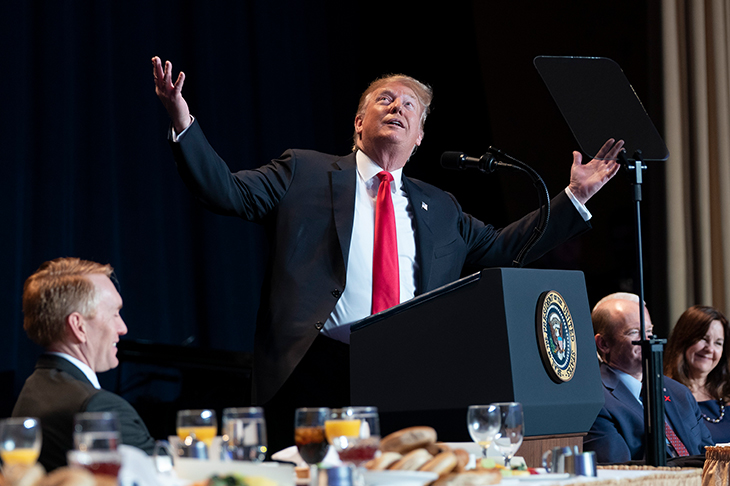
We might now ask, as the post-Liberation Day era plays out, if Trump does have the cards. Certainly, on 8 April, with the stock market still languishing and Beijing matching every new tariff hike with one of its own, Trump began to sound rattled. ‘I know what the hell I’m doing!’ he declared at a national Republican dinner. The next day, nonetheless, he abruptly postponed his tariffs on the 75 (we are told) countries which had chosen negotiation over retaliation in response to Liberation Day.
Gaby Hinsliff, writing for the Guardian, was not alone in maintaining that Trump abandoned his tariff gambit after being ‘spooked by a concerted revolt in the bonds market’. Hinsliff added, ominously enough, ‘the damage is done’. Certainly, Trump acknowledged that his 90-day pause was the result of higher-than-anticipated blowback: ‘I thought that people were jumping a little bit out of line. They were getting yippy, you know, getting a little bit yippy, a little bit afraid.’ Maybe it was Trump himself feeling ‘a little bit yippy’. Perhaps he didn’t have the cards after all.
That is all one way to interpret the aftermath of Liberation Day. Eswar Prasad, writing for Foreign Affairs, argued that Trump’s tariff gambit will ‘define Trump’s legacy not as a savvy businessman but as a destructive and petulant hindrance to economic progress’. Sending global stock markets into a tailspin seemed to corroborate the narrative that the Disruptor-in-Chief is a dangerous menace with no upside.
The announcement of the 90-day pause might have sent stock markets soaring but two days later they fell again, although not as precipitously as before. ‘Nothing is certain now,’ Time magazine lamented, ‘but uncertainty.’ Liberation Day has even exposed fissures in the Maga movement. Elon Musk (Dark Maga) wants fair trade but not enduring tariffs; he called Peter Navarro (Red Maga) a ‘moron’ for wanting to re-industrialise America on the back of permanent tariffs. So where does Trump stand on this? Nobody can be sure.
What explains Trump’s rashness? Trump, as I noted here in 2016, has the disposition of a revolutionary, notwithstanding the Brioni suits and the diamond cufflinks. Even ‘Liberation Day’ smacks of insurrection and rebellion. If Trump is in any way a conservative it is not in temperament. Driven by ‘instinct’ – his word – he appears unafraid of generating chaos. Why? Because out of chaos arises opportunity, at least for the ‘stable genius’ with the perspicacity to identify and exploit it.
Despite eliciting a new era of anti-America resentment throughout the world, one world leader after another – with the exception of Xi Jinping – took Trump’s advice not to impose tit-for-tat tariffs on American goods however unfair and arbitrary they seemed. Trump, ever the opportunist and wheeler-dealer, repackaged the embarrassment of the 90-day tariff pause as a reward for every leader who bent the knee.
Bluntly put, Trump has reason to believe – or boast – that he now owns them, from Ursula von der Leyen and Keir Starmer to Nguyen Phu Troy and our own Anthony Albanese. In assuaging the fears of the ‘panicans’, Trump had cunningly outmanoeuvred them. China excepted, you could be forgiven for thinking this sounds less like a looming trade war than a chapter out of The Art of the Deal.
Moreover, the post-Liberation Day era has isolated Beijing. Not since the Sars-CoV-2 virus escaped Wuhan’s National Biosafety Laboratory has Chairman Xi’s regime been so vulnerable. Did Trump plan this? Who knows. What we do know is that Trump has long railed against Beijing’s manipulation of currency, predatory pricing, intellectual property theft, corporate subsidies, non-monetary import barriers et al. and now Xi currently finds himself alone in his defiance of Liberation Day – and Trump believes he has his number: ‘China also wants to make a deal, badly, but they don’t know how to get it started.’
Businessman Kevin O’Leary is urging the Trump administration to use this uptick in leverage to hike tariffs from 145 per cent to 400 per cent. China, already adrift with falling house prices, tepid business growth and over-dependence on the American market (some 18 per cent of total exports) would be seriously compromised. America? Not so much. Maybe Trump’s verdict on China’s retaliatory tariffs will be proven right: ‘They played it wrong. They panicked.’
Got something to add? Join the discussion and comment below.
You might disagree with half of it, but you’ll enjoy reading all of it. Try your first month for free, then just $2 a week for the remainder of your first year.