What do you expect to see when you sit down to watch the Olympics, aside from a tedious, politically correct, four-hour opening ceremony that would have made Liberace vomit? Unbelievable skill – hopefully. It is an opportunity for athletes – who have sacrificed a normal family life to one dedicated to years of hard work and commitment – to compete with the world’s best. So you can expect to see feats of incredible human ingenuity, strength and drama – hopefully. However, there is one thing we can all agree we expect to see: fairness. This pertains to sport in general, indeed to life. It’s what a high-trust society, our shared sense of community, is based upon.
What I find funny, and to be honest, extremely predictable, is how fast these old-fashioned traditional values get jettisoned as soon as trendy, more progressive, quotable shibboleths enter the scene.
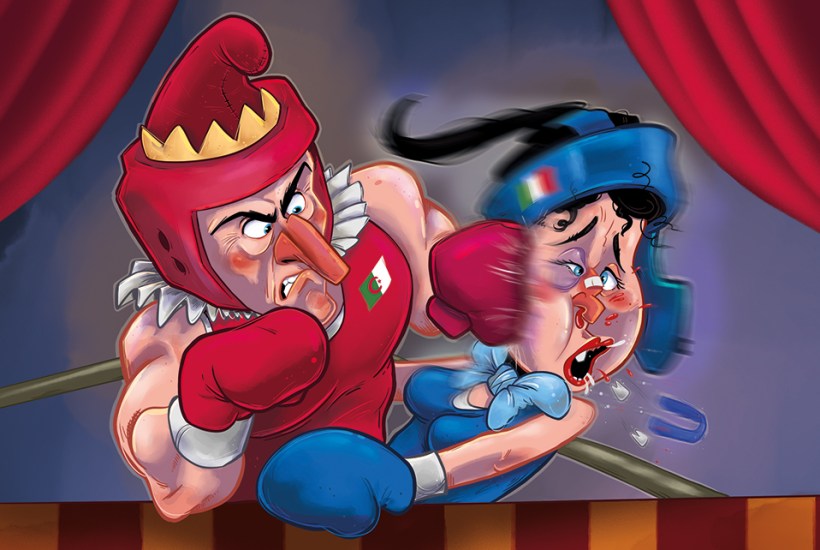
Imane Khelif, an Algerian boxer, started her quest for gold in the women’s 66 kg weight class on Thursday. A 25-year-old Italian woman named Angela Carini was in Khelif’s path. Except there’s one problem with this otherwise noble sporting narrative: Khelif is said to be a man. In other words, XY chromosomes, or Y for Y-fronts for those of you who are not scientists. Though they call this nonsense ‘inclusion’, the Olympics, in their exalted state of wisdom, have an open door policy for all ‘sex variations’ – even if the person has been disqualified from previous major competitions for failing gender tests, as Khelif was in New Delhi last year.
As expected, the fight was a bloodbath. It made Apollo Creed vs Ivan Drago look like a child’s pantomime. Khelif’s first punch dislodged Carini’s chinstrap on her head guard, and her shorts were drenched in blood from his second. Another blow left her unable to breathe. She returned to the corner, raised her hand, and withdrew. She later declined to shake hands with Khelif. The entire sordid affair lasted a mere 46 seconds. Carini fell to her knees and sobbed, ‘Non e giusta’, (it’s not fair). Well, progressive ideology does like breaking new ground and defying convention. 2024 will go down in history as the year that male violence against women became an Olympic sport. We have at last reached full inclusion for games that purport to reflect true gender parity.
It is not just Khelif. The following day, Taiwanese boxer Lin Yu-Ting destroyed an opponent from Uzbekistan. For the record, Ting lost a bronze medal at the World Championships last year after ‘she’ failed a sex test. Lin weighs 57 kg. The existence of distinct weight categories is a relief. Imagine the ridiculous scenario in which we would have been forced to watch two men compete in the women’s boxing competition for the gold medal if there had been no criticism or pushback.
The rationale behind weight divisions is straightforward: fairness. Equality of opportunity is ensured by a level playing field. Otherwise, why do sports’ governing bodies waste time segregating the sexes?
Men are stronger than women, and I apologise if this seems controversial. A study from the University of Utah found that men can punch 162 per cent harder than women, as the first openly transgender mixed martial artist fighter, Fallon Fox, demonstrates. He gave his female opponent, Tamikka Brents, a fractured skull in a fight in 2014.
Khelif was ‘born female, registered female, lived her life as a female, boxed as a female, has a female passport’, according to Mark Adams, an Olympic spokesman. Legality has no bearing on biological sex; a passport is meaningless. ‘This is not a transgender case,’ Adams said. In one highly subjective sense, he is correct. Khelif was not sporting a blonde wig, nor had he affected a feminine walk. He is mistaken, though. You are a man by definition if you are born with XY chromosomes.
Caster Semenya, a former Olympic athlete, possesses XY chromosomes. was born with internal testicles that produce testosterone and a vagina. Due to the high presence of testosterone, Semenya’s body underwent a radical change as she grew older, building muscle, strengthening bones, and enlarging the lungs, which enabled her to train harder and longer than women.
In Rio de Janeiro, Semenya won gold in the 800 meters. However, it’s important to remember that the race’s silver and bronze medallists shared a condition known as disorder of sex differences with Semenya. The podium photo is quite revealing: it genuinely looks like three men. It is an unsettling flashback to the 1980’s Olympics, when East Germany doped women with hormones in order for them to win a medal. Of course. There’s nothing wrong with looking like a man. Unless, of course, you’re attempting to win a women’s competition and, well, you just happen to look like a bloke, because you are, indeed, a bloke. What’s happening now is similar to the controversy of the 1980s. It’s worse in many respects because this scandal isn’t being discreetly hidden.
Fortunately, I have a solution. The Enhanced Games™ is the brainchild of Australian lawyer Aron D’Souza. Its stated goal is to discover what can be accomplished when all restrictions are removed. They value freedom. In this case, the freedom to use a wide variety of banned substances and performance-enhancing drugs. The billionaire co-founder of Paypal, Peter Thiel, has made an investment, and numerous other venture capitalists have expressed interest.
In the Enhanced Games, spectacle takes precedence over sacrifice and dedication. Who wants to watch eight sprinters in the 100 metres cross the line within a margin of 0.05 seconds when someone can finish in a cloud of smoke that scorches the track like Doc’s DeLorean?
As we go to press, Khelif has advanced to the finals and may even win Gold. Even so, I’m sure he can still compete in the Enhanced Games if he is banned.
Carini said she had never felt a punch quite like it after the fight. The rest of us have. It’s the biggest blow to fairness the sporting world has ever experienced.
Got something to add? Join the discussion and comment below.
You might disagree with half of it, but you’ll enjoy reading all of it. Try your first month for free, then just $2 a week for the remainder of your first year.