
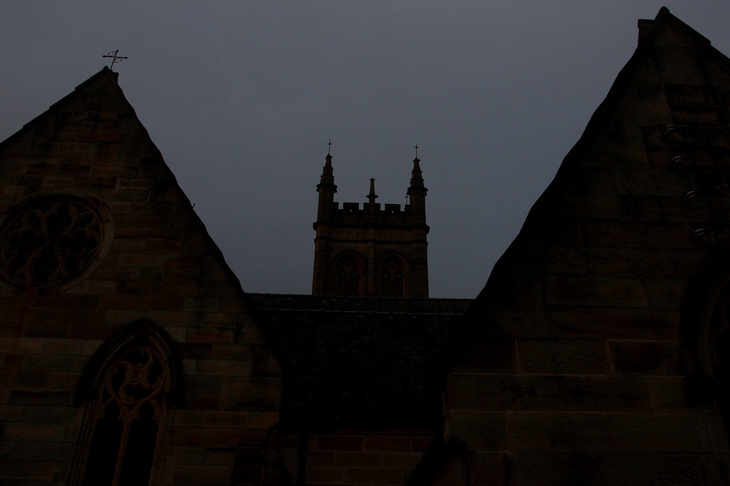
The defection of a number of Australian Anglicans from their Church might not seem of more than local importance but look closer and you will see it as part of a wider pattern. It’s a warning flash in a storm rolling in from the United States that is going to break all over the West, as the ‘silent multitudes’ turn against once-respected institutions now in thrall to leftist obsessions about sex, race and history.
At the heart of this rebellion is a sense of impotence – these are people who have no voice in the media – and a conviction that the radical social agenda has undermined the certainties essential to a cohesive society. Identity politics has riven our community into mutually hostile tribes and the leftist denial of the existence of objective truth deprived us of a framework in which to reason with each other.
No one says the Anglican Church is that far gone, but the defectors, led by a former archbishop of Sydney, do say that it has ‘departed from the values of the Bible’, particularly in some of its bishops appearing not to have absolutely ruled out the possibility of same-sex marriage in church. This has been criticised as ‘narrow-minded’ and ‘out of touch’, not least by apologists for the mainstream Church.
But arguably it only seems so because almost the entire Australian articulate class has swallowed so much ‘rainbow’ propaganda that it now considers anything once accepted as part of normal morality an example of antediluvian bigotry. To the defecting Anglicans gay marriage, and the whole range of contemporary theories on sex and gender, are symptoms of a wider disregard for the evangelical and biblical principles of pure Christianity. God made men and women, not a mix-and-match set of bodies and preferences.
The new traditionalist group, organised into a ‘diocese of the Southern Cross’ has the support of GAFCON, the international ‘global conference’ of evangelical Anglicans, which has a strong following in the United States.
And not coincidentally it is in the United States that opposition is most spectacularly gathering momentum to the anti-rational, anti-logical, ideologically Marxist-derived groupthink that now prevails in government, education and media. The storm will burst over American heads at the November mid-term elections. The elite Democrat establishment, the politicians and the powerful administrative class hand in glove with them, will be up against a wave of mostly young Republican candidates, some of whom call themselves ‘post-conservative’ – ‘There is nothing to conserve,’ says one of them, ‘you have to start again.’ Adding urgency to the drive for change is the seemingly inexhaustible ineptitude of the Biden administration.
It could turn nasty. If the Democrats are trounced, the street-fighting thugs who hate Republicans will try and burn down Republican-voting cities, just as they did after George Floyd was killed by an over-zealous copper in 2020 – but this time they’ll have not even a semblance of moral justification, and without Democrats running the show they will be forcibly opposed. It’s a recipe for blood in the streets but the elites will have only themselves to blame, since they have dismissively ignored the interests of the wider American public in their determination to deconstruct the country and, effectively, replace ‘white supremacy’ with white subordination.
In Australia, successful leftist efforts to apply the techniques of American racial grievance to our historically different situation could soon divide our nation. Labor has connived in this.
It’s a tragic prospect, not least because we have so far been spared extremes of political division. We have been peacefully governed. We don’t really respect politicians but are resigned to putting up with them. Whether this patience will survive the effects of the Albanese government’s – and the appalling teals’ – climate zealotry is another thing. Cold showers and no power for the aircon on a sweltering day could awaken the rebel in the mildest citizen.
The Liberal party is no use as an alternative. Post-Morrison it is seen as compromised and incompetent. Like Anglicanism, which it demographically resembles, it is a ‘broad church’. Its leadership has tried to court electoral popularity by adopting, slightly toned-down, the policies and language of the Left, leaving the party’s conservative-leaning membership largely unrepresented. Many would support an unhesitatingly conservative Liberal party: there too are the seeds of a split or a new foundation.
Anglicanism is not the only denomination in Australia where the dichotomy between leaders and led is evident. A like degree of disunity prevails in the Roman Catholic Church where a plenary council, beloved by progressive bishops, has signed up to the full leftist repertoire on race, climate, etc. This can hardly reflect the views of most practising Catholics – indeed the council itself is unrepresentative, witness the fact that out of a million Catholics in one of Australia’s largest archdioceses, Melbourne, a mere 86 lovers of their own voices applied to take part in it.
The Roman Catholic Church is not in the same straits numerically as the Anglicans, but falling attendance suggests it soon could be. Its one growth point is the old Latin or Tridentine Mass, which attracts many young people and families worldwide.
The present pope dislikes it, and has restricted its celebration, yet the old Mass is a huge opportunity for the Catholic Church because it shows that traditional Christianity can answer a perceptible spiritual hunger, especially in the young. Unless this papacy, with its fixation with ‘synods’ and inability or unwillingness to inspire simple faith, ends soon, and is succeeded by one anchored in the basics of Catholic Christian belief, this potential for growth could be dissipated. Or will it burst through into schism like the Anglicans? That would be in accord with the temper of the times.
Got something to add? Join the discussion and comment below.
You might disagree with half of it, but you’ll enjoy reading all of it. Try your first month for free, then just $2 a week for the remainder of your first year.


